The worktop is the most punished surface in any kitchen — water, heat, knives, oil, acids every day for 10–20 years. Most people pick by colour. The thing that actually matters is how the material behaves under daily use. Here’s the practical comparison we’d give a friend.
Five materials, five different scenarios
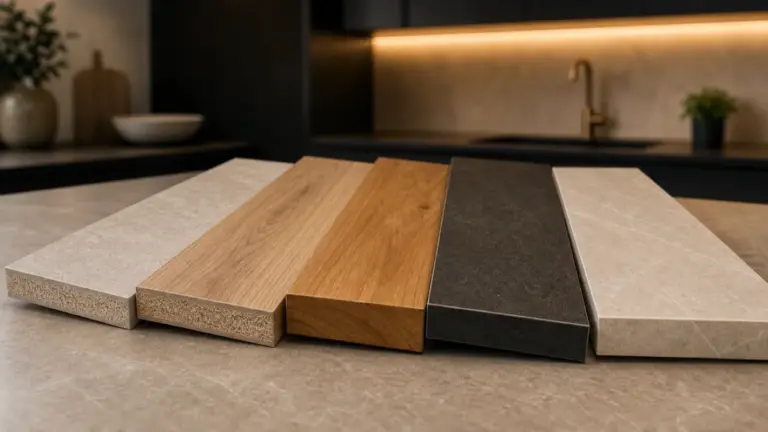
Czech kitchens (and most across Europe) use one of five materials: laminate chipboard, veneered chipboard, solid wood, HPL compact laminate, engineered stone. Each has clear strengths and weaknesses. Here’s a quick comparison, then a deep dive on each.
| Material | Price | Durability | Maintenance | Main weakness |
|---|---|---|---|---|
| Laminate chipboard | Low | Medium | Easy | Swells around sink |
| Veneered chipboard | Medium | Medium | Demanding | Moisture, edges |
| Solid wood | High | High* | Oil 2×/year | Cracks without care |
| HPL compact | High | Highest | Minimal | Price, fewer décors |
| Engineered stone | Highest | High | Minimal | Heat sensitive |
* with regular care
1. Laminate chipboard
The standard choice for normal households. Chipboard core covered with laminate, wide range of décors, low price. Main weakness: moisture around the sink.
Pick this when
- Budget build where the worktop is the most expensive item
- Apartment block / temporary kitchen (planned replacement within 5–8 years)
- Rental, where premium materials aren’t worth it
Avoid when
- Households with kids and intensive use
- You want the kitchen to last 15+ years without significant maintenance
- You want an undermount sink — laminate can’t take it
If the sink cut-out isn’t perfectly sealed, laminate swells within six months. That’s not a material flaw — that’s a fitting flaw.
2. Veneered chipboard
Same chipboard core, but a thin layer of real wood on top. Looks like solid wood, costs like upper-tier laminate. Main weakness: veneer is thin and sensitive to moisture and mechanical impact.
Pick this when
- You want a wood look without the price and care of solid wood
- Kitchen with moderate daily use
- Design-focused project
What people miss
Veneer can’t be restored by sanding the way solid wood can — it’s only 0.3–0.8 mm thick. A deep scratch is permanent or means replacing the whole worktop.
3. Solid wood
A full piece of wood — oak, ash, walnut, acacia. The most natural option, develops character with age, can be refinished by sanding even after 15 years.
What it needs
- Oiling twice a year — more often around the sink
- Dry wipe after any cleaning with water
- Stains from coffee, wine, acids handled immediately, not a week later
- Sanding and re-oiling every 5–8 years
Avoid when
If you’ll never touch it with oil — solid wood without care cracks along the grain, especially at the hob and sink. Then it looks worse than basic laminate.
4. HPL compact laminate
The most durable material on this list. Made from many layers of paper and melamine resin compressed at high pressure. No chipboard core — moisture-resistant through and through.
Why we recommend it for high-use environments
- Resistant to impact, abrasion, chemicals and UV
- Moisture-resistant even at the sink — no swelling
- Supports undermount sinks and flush-mount appliances
- Invisible joints between sections — looks monolithic
- Hygienic surface, easy to wipe down
What’s worse
- Higher price — typically 2–3× laminate
- Fewer décor options
- Higher weight — more complex to install
For a household with kids or a rental with tenant rotation, compact is the best balance of price vs lifespan vs minimum maintenance.
5. Engineered stone (quartz / acrylic composite)
Premium option for visual projects. Mineral fillers in a resin matrix. Can be shaped into almost any form, joints become nearly invisible.
What it does well
- Monolithic look across the whole worktop
- Integrated sinks (shaped directly from the slab)
- Moisture- and stain-resistant
- Easy to clean
What it doesn’t do
- Doesn’t handle direct heat — a hot pot on the surface leaves a mark or causes a crack
- Small scratches stay visible on glossy finishes
- Highest price — typically 3–5× laminate
If you pick engineered stone, plan for trivets under hot pots and accept that the material is a design choice, not a maximum-durability choice.
How to choose: decision matrix
Tight budget, kitchen will be replaced within 5 years
→ Laminate chipboard, with careful sealing of the sink cut-out.
Want a wood look at a reasonable price
→ Veneered chipboard — accepting limited repair options.
Wood lover, kitchen for 15+ years
→ Solid wood — if you’re willing to oil it twice a year.
Kids, intensive use, minimum maintenance
→ HPL compact laminate. Best ratio of durability to upkeep.
Design brief, monolithic look, island sink
→ Engineered stone — aware that it’s heat-sensitive.
What we do
We install and replace worktops in all five materials. If the kitchen is already in place, the worktop can be replaced without removing the cabinets. Cut-outs, joints, edge sealing: Worktop installation and replacement.