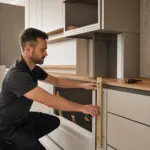
A small document with a big effect. Whether the manufacturer accepts a warranty claim six months later — for a sagging worktop, doors that stopped lining up, or a faulty dishwasher — often depends on it. Without it, you only have an invoice. And an invoice doesn’t say anything about the condition the kitchen was handed over in.
Why this matters
Customers usually focus on price, timing, worktop material. The handover protocol gets almost no attention — until they need to file a claim. Then they find out:
- IKEA won’t accept a claim without a protocol
- The appliance supplier asks for proof the installation followed their specifications
- Home insurance won’t cover damage if you can’t document the state at handover
And at that point it’s too late.
What a handover protocol actually is
A handover protocol is a written document describing what was installed, by whom, in what condition. The installer issues it on the day of handover — typically in two copies (one for you, one for the installer).
It’s not a “stamped invoice”. It’s a technical description of the work, used as evidence in case of dispute that:
- The specific part was undamaged at the time of installation
- The appliance was functioning when commissioned
- Joints, cut-outs and anchoring followed the manufacturer’s spec
- The worktop was installed per the technical data sheet
Without a protocol, the manufacturer has every right to assume the issue came from a bad install. And they’ll reject the claim. At that point all you have is an invoice and an argument.
What must be in the protocol
Job identification
- Handover date
- Installation address
- Customer and installer name
- Job / invoice number
Installation description
- Brand and product line of the kitchen (IKEA METOD, Bauhaus, DanKüchen…)
- List of built-in appliances with model numbers
- Type and dimensions of the worktop
- Sink mounting method (top-mount, flush, undermount)
Functional tests
- Oven — connection, test run, OK
- Hob — connection, test, OK
- Dishwasher — water, waste, electrical, test cycle, OK
- Hood — extraction, controls, OK
- Fridge — connected, cools to target temperature
Handover condition
- No visible defects / with note XYZ
- Any deviations from the project
- Use and maintenance recommendations
Signatures
- Installer
- Customer (with “not yet tested” note where applicable)
What to do if the company won’t issue one
That’s a red flag. If an installer refuses, can’t prepare one, or only offers it “for an extra fee”, it typically means one of three things:
- It’s not part of their standard and they have no system for it
- They don’t want to be liable after handover
- They work with new staff with no claims experience
Before the work starts, get it written into the contract or binding quote: “Handover protocol is part of the deliverables”. If they refuse, walk away.
Why we issue one automatically
For us the protocol is part of every job — no separate request needed. The reason is simple: in 10 years we’ve dealt with enough claims from customers who called us as the “fix-it firm” after a bad install elsewhere. In every case where a protocol existed, we knew where the original installer’s responsibility ended and ours began. Where it didn’t — responsibility ping-ponged like a hot potato.
Details on the installation service: Kitchen installation.
What our protocol looks like
Our protocol runs to 2 A4 pages, clear structure, numbered job. Two copies — one stays with us, one with you. Save it digitally too — take a photo right after signing.
If you sell the flat with the kitchen included or hand it over to a tenant, the protocol becomes part of the property handover document — the buyer or tenant sees exactly what they’re getting.
What to check before signing
Before signing the protocol, walk through the kitchen calmly. Small things often surface that the installer missed — and they’re harder to claim after signing:
- Door alignment — all gaps equal, no skewed doors
- Drawers — all close cleanly, none rubbing
- Worktop — no bubbles, clean edges, sealed sink cut-out
- Appliances — all connected, tested, doors open fully
- Plinths — fitted, no gaps
- Wall joints — silicone or trim, no exposed seams
If something’s off, write it into the protocol as a note — a decent firm fixes it within a week. A signature without notes legally means you’ve accepted the kitchen “as is”.
Summary
A handover protocol is a small document with major impact. Without it, you have no basis for a claim with the manufacturer, appliance supplier or insurance. When picking an installer, always require it up front — in writing, in the quote or the contract.